Hormones, stress and ranking

The level of the hormone testosterone is a good measure of social dominance both in monkeys and humans. Higher testosterone levels were measured in socially dominant individuals as compared to those of socially inferior individuals. Experiments suggested that victory and defeat implied the increase or decrease of testosterone level of male sportsmen (observed not only in football, rugby, tennis and wrestling, but also in chess). Changes in the testosterone level was measured not only in sportsmen, but also fans of sporting events.

Three hormones, adrenaline, cortisol, and norepinephrine show correlation with stress. Is it good to have some stress? Partly yes, stress is to help us animals to survive in a dynamic environment. As new threats arise, the animal must be able to quickly perceive, comprehend and asses the situation and making plans and act accordingly. When an animal is stressed, its pituitary gland and adrenal cortex release stress hormones. These stress hormones will then have a number of physiological effects on the animal’s body, such as increased heart rate, increased muscle tension, and suppressed digestion and reproduction. Naively it was believed that the subordinate members of a group were the ones to display greater levels of stress hormones. This was imagined to be true due to the stress of losing a fight or not having access to priority resources. Data both on monkeys and humans, however, are at least, controversial. High-ranked animals also show stress, but its duration is short-lived, and helps them to win the next competition (which implies further increase in their rank). Lower-ranked males, who are subject of being bullied, have chronically elevated stress hormones, and it is really harmful, and leads to further reduction of their social rank.

Here is a listicle ”8 Reasons a Little Adrenaline Can Be a Very Good Thing”

http://mentalfloss.com/article/71144/8-reasons-little-adrenaline-can-be-very-good-thing:

1. It might help you on a deadline
2. Your vision gets better
3. You’ll breathe easier
4. Other experiences are heightened
5. It can block pain
6. It can boos your immune system
7. You’ll get to tap into a little extra strength
8. It might help slow aging
We already know, lists are just lists. I don’t read this listicle as the ”final truth”, but as an
educated opinion.

Bridges to connect mathematicians to neurobiologists, economists and even to philosophers?

János (John) Szentágothai (JSz), one of the most distinguished neuroanatomist of the
XX. century,  has an Erdős number 2, since he has a common paper with Alfred Rényi published in 1956 (actually about the probability of synaptic transmission in Clarke columns). It seems to be a plausible hypothesis that JSz is the bridge to connect the community of mathematicians to neurobiologists and even to philosophers. JSz has a common book with two other scientific nobilities, Nobel prize winner neurophysiologist Sir John Eccles , and with Masao Ito. In this case, JSz should be a bridge between two separated communities. It is interesting to note, that JSz himself was thinking on the graph of the network of the cerebral cortex, in terms of what it is called today “small world”. JSz hinted that the organization of the cortical network should be intermediate random and regular structures. He estimated that “any neuron of the neocortex with any other over chains of not more than five neurons of average.” . Sir John Eccles has a book with Sir Karl Popper The Self and its Brain) so there is a direct math-neurobiology-philosophy chain.

Another non-mathematician with Erdős number 2 via Rényi is András Bródy, a Hungarian economist. They also published a paper in the same memorable year, in 1956. (It was about the problem of regulation of prices.) So, another question is induced. Since most likely all people with number 1 are mathematicians, it would be interesting to know, how many non-mathematicians have Erdős number 2, and how any other scientific communities are involved in the Collaboration Graph?

Dominance and Prestige: please, help!

I read today Jon K. Maner’s paper “Dominance and Prestige: A Tale of Two Hierarchies “.

Dominance and prestige are two distinct mechanism navigate in the to social ladder. Dominance is an evolutionary more ancient strategy, and is based on the ability to intimidate other members in the group by physical size and strength. The group members don’t accept the social rank freely, only by coercion. Prestige is based on skills and knowledge appraised by the community, and it is maintained without pressure. It is not a surprise, that the people adopting different strategies differ in their personality traits. People using dominance are more aggressive, manipulative, and narcissistic. However, people who use prestige instead are more conscientiousness, had higher self-esteem, and are able to make agreement with others. Both strategies might have some negative consequences. Dominant leaders has a higher priority is to keep power than to achieve group goals, while leaders having prestige sometimes prioritize their social approval over group goals.

Several years earlier Cheng JT and his coauthors also analyzed the two pathways:

Two Ways to the Top: Evidence that Dominance and Prestige are Distinct yet Viable Avenues to Social Status

They gave examples for the two ways:

From 1945 to 1980, Henry Ford II—grandson of Henry Ford, founder of Ford Motor Company—built Ford into the second largest industrial corporation worldwide, amidst a turbulent post World War II economy. Ford II attained his success, in part, by developing a  reputation for erratic outbursts of temper and unleashing humiliation and punishment at will upon his employees, who described him as a terrorizing dictator, bigot, and hypocrite. When challenged or questioned by subordinates, Ford II would famously remind those who dared  contradict him, “My name is on the building”. Yet, despite being widely regarded as one of the most intimidating and autocratic CEOs to ever grace the company, Ford II was an enormously  successful leader, and he has been credited with reviving the Ford business legend during a period of turmoil and crisis (Iacocca, 1984).

A contrasting example of effective leadership can be seen in the case of Warren Buffett,  chairman and CEO of Berkshire Hathaway, who was ranked the world’s third wealthiest person in 2010. Unlike Ford II, Buffett ran his company by developing a reputation for subtly steering rather than controlling every decision-making process. His autonomy-generating approach to  leadership is said to instill confidence and boost performance among his executives, whom Buffett describes as brilliant coworkers he trusts and respects. Buffett thus exemplifies a style of leadership quite opposite to that of Ford II, yet both individuals reached what can only be  considered the highest level of social status possible in any industry. This raises the question: are  here multiple ways of attaining social status and influence in human societies?

Please, could you write examples for the two prototypes! (My Hungarian fellows: please please forget about the present day local “heroes”!


From the cognitive bias of the individuals to the wisdom of crowds and back

As I am thinking about my own way of thinking when I am assigning scores to students knowledge, motivation and ability, it would not have any sense to deny the subjective elements of my evaluation method. Somehow I integrate my memories about the student’s character, attitude, performance. Of course, with close students I had numerous conversations about very different aspects of life, from work ethics to philosophy of science, and from politics to love. I try to be objective, but it is difficult to avoid what is called halo effect. The halo effect is a form of cognitive bias, in which our overall impression of a person determines our evaluation of specific traits and performance. The emergence of the concept goes back to Edward Thorndike (1874-1949), a psychologist who used it in a study published about hundred years ago to describe the way that commanding officers rated their soldiers. I have been finding very difficult to detach to judge the motivation and the performance of students, or her likability to her analytical skills. After I became aware of the halo effect, I make more effort to rate each items independently from all other items. Fortunately, a student is evaluated by several other people, so maybe (yes, maybe) the individual biases averaged out. Collective wisdom is supposed to be more efficient than the individual judgment, as we discuss now.

Francis Galton (1822-1911), a half-cousin of Charles Darwin, loved to count and measure everything. While he has a bad reputation for introducing the field of eugenics with the goal of improving the genetic quality of human population, he contributed to make among others the fields of biology, psychology and sociology more quantitative. A famous story tells that he visited the West of England Fat Stock and Poultry Exhibition, where among others an ox was on display. He asked the guests to estimate the weight of the animal. About 800 people participated, and the median estimate was very very close to the real value. (The median value is the one lying at the midpoint of a frequency distribution of observed values.) The take home message of this observation is that the accuracy of the estimate of a population exceeds the ones of the individual experts. The notion called and popularized, as The Wisdom of Crowds, which was the title of a book of James Surowiecki in 2005. We don’t have to believe that the opinion of the crowd is impeccable. Surowieczki argued that the estimation of the crowd is really good if the people’s individual opinions are independent. Nietzsche recognized and sharply criticized the herd instinct, we humans have. If we let’s influence ourselves (led by others like a sheep, as Nietzsche writes) than the crowd’s calculation leads to biased result. I am influenced by the works of a leading computational social scientist group in Zurich, Switzerland directed by Dirk Helbing. They gave several neutral questions to people, who had to estimate some data related to the demography or crimes (population density, the number of rapes in a given year in Switzerland, etc…). If people did not communicate with each other, they got a better result than when they could change opinion with each other. Actually the range of estimates was reduced, and the center of opinions has been shifted from the real value. Their finding was surprising. Generally we believe, that consensus implies better decision making, however, it might happen that initially small deviations from the ”good” value are amplified by the herding mechanism.

What we see is that if opinions distribute over a larger range, the estimate is better. Along the same line, diverse population of problem-solvers counts better than even the much more uniform well-performing solvers, as the model calculations of the complex systems scientist Scott Page from the University Michigan demonstrated.

Let’s make a step back! Can we consider that even an individual is a crowd? First, there are people who might have more than one opinions about something or somebody. Also, people may give different estimates to the same quantity, several weeks later. As it turned out that averaging is useful, even individuals may benefit by integrating their different perspectives: crowd and crowdsourcing may exist within a single mind!

From Al Capone to the listicles

Al Capone (1899-1947), the infamous boss of an efficient organized crime empire, was officially called ”public enemy number one” in 1930 by the Chicago authorities. As we know, ”there is nothing new under the Sun”, even in the Roman times Cicero used the notion of public enemy (host publicus). The Chicago Crime Commission released a list of twenty-eight men labeled ”public enemies”, and Al Capone’s name was on the top of the list. He also leads the list of the The 17 most notorious mobsters from Chicago, as he managed to combine the characters of a mobster as a pop star. It is not surprising that history.com published a listicle with the title 8 Things You Should Know About Al Capone. Totally accidentally, an article in magazine of the University of Chicago (written by the linguist Arika Okrent) nicely explains that listicle is a literary form, similarly as limerick or haiku. If you see a number in the title of the listicle, you already know an important information about the quantity you suppose to receive. You could decide, yes, I am ready to spend a specified affordable time to know her list. Probably still number ten appears most frequently in the titles, other numbers are selected to make a little more fun. Listicles provide ordered lists, so in the title announces that ”The best of”, ”The most of “, or the ”The worst of” something or somebody will be listed. Our brains like the flow of linearly arranged items, so we buy it.

Here is my first haiku:

Three lines – one listicle 

Our brains like lists
the number of items known
oh, the end is here.

To-Do lists

Many of us prepare To-Do lists. It is a prioritized lists of all the tasks that we need to carry out generally ”soon”. So, first we make a list of everything that we have to do, than make a ranked list with the most important tasks at the top of the list, and the least important tasks at the bottom. It is not so simple to prepare a To-Do list, and the question is whether we have some ”best” algorithm of constructing one. There are different features of tasks we have to do it, say urgency, expected penalty for postponing, the time you should assign to do the job, etc. You certainly can not postpone to pick up your kid from the kindergarten. If your boss asks you to tell your quick opinion about a situation (maybe in a form of list) at noon, you will decide whether you do it before or after lunch (well, an eager beaver could do instead of lunch). Some people believe that a LONG To-Do list is the proof of their value and indispensability. Not speaking about the sad fact that cemeteries are full with indispensable people, successful people are able to outsource their tasks, as most famously Tom Sawyer did with the whitewashing of the fence.

It is reasonable to have a To-Do lists for different time scales, for short term, intermediate term and long term projects. ”Short term” might be one day, or in busy periods maybe two hours. We should write down things, and it is useful to use with pen and paper (used envelopes are very good for this purpose!). Our conscious mind is able to keep not more than four-five things at once, and generally we have more things to do one day. (Can you write down how many things you have to do today, or if your read this paragraph in the late evening, than tomorrow?)

Hundred years ago, Ivy Lee, an industry consultant suggested a seemingly simple technique to the steel magnate Charles M. Schwab.

  • At the end of each workday, write down the six most important things you need to accomplish tomorrow. Do not write down more than six tasks.
  • Prioritize those six items in order of their true importance.
  • When you arrive tomorrow, concentrate only on the first task. Work until the first task is finished before moving on to the second task.
  • Approach the rest of your list in the same fashion. At the end of the day, move any unfinished items to a new list of six tasks for the following day
  • Repeat this process every working day.

The technique worked, and Lee got a check of $25.000, (and you can multiply this number with fifteen to calculate its equivalent today. Since I am very modest, send me only the original amount if the technique works for you.)


Just I simple like it

Between One and Ten with the contribution of Casey Kasem co-founder of American Top 40 Letterman parodized the nonsense of ranking. (if you don’t know, or even if you do see).

The hidden rules of the credit score game

Algorithmic bias

Experts of one of the world leading big law firms, White & Case, explained in their paper Algorithms and bias: What lenders need to know that even clearly unintentional algorithms direct financial technologies may lead to discriminative decisions. Why? Creditors and lenders have access now, in the age of Big Data, to so-called nontraditional data, such as Internet activity, shopping patterns and other data which are not necessarily directly related to creditworthiness. These data are analyzed by using the techniques of now very popular machine learning.

Traditional algorithms use the rules of arithmetics and logic defined by the designer of the algorithm. Say, IF Borrower payed back her previous credits without any delay THEN increase her credit score by X points. But  machine learning  techniques relies don’t have a previously defined algorithm, they generate algorithms based on patterns found in large datasets. Take for example the approval of loan request. The software has stored analyzed data of financial behavior of many thousands of previous customers. Loading the credit history of a new applicant as input data, a machine learning algorithm might calculate the output, something like the probability that the applicant will default.

There are justified concerns that algorithms might bring biased, and may be unfavorable decisions for minorities. Ideally, the decision makers should take into account the data permitted by ECA for the borrower only. But we live in networks surrounded by our neighbors, friends, and peers etc. If the creditors analyze data of your social network friends to rate your creditworthiness, it might lead to discrimination based on data creditors are not permitted to consider. Living address might matters a lot, and ZIP code is considered a dangerous variable, and the term redlining expresses the discriminatory practice (historically for people lived in black inner city neighborhoods).

A machine learning algorithms may find that there is a correlation between your creditworthiness and the financial behaviour of your friends or neighbors. It is a complicated situation: a creditor cannot deny your request on the basis that many of your friends delayed to repay their loan. Also, they should explain the basis of their credit request denial. But if nontraditional data are used, it is very difficult to give transparent and understandable explanation.

It is understandable that data from your social network cannot be used for evaluating your financial future. However, we choose many our future activities based on recommendation systems. These recommendations influence our choices of hotels, restaurants, dating partners, movies, just to give an unranked list.
The recommender algorithms use data also about ”stuffs what my friends like“. We will discuss in more detail in subsection Sec:10.1.

Should we like algorithms? If you are ready to answer the question with ”No”, did you think whether or not we better off by returning to the personality-based subjective credit evaluation?

In May, 2016, the Obama administration’s The Treasury Department issued a white paper titled,  Opportunities and Challenges in Online Marketplace Lending. In addition to the traditional players, online marketplace lending companies has been formed emerged offering faster credit for consumers and small businesses. It was a good news that the Treasury Department found important to analyze the opportunities and risks presented of this new type of crediting system.

Towards fair algorithms?

Computer scientist realized that algorithms might lead even unintentionally to discrimination. Why? Data mining methods are based upon assumptions that comes from the pioneers of modern science, as Galileo, Kepler and Newton: looking into the data from the past implies our ability to predict the future. While this method worked wonderfully to predict the motion of the planets, should we also assume that historical data for the social behavior are useful for prediction?

There are now algorithms for forecasting crimes based on historical data. Patterns for time of the day, seasonality, weather, location (vicinity of bars, bus bus stops factors), crime level in the past and similar data help police departments to have a better chance to prevent potential crimes. As always, while the goal of \emph{predictive policing} promises to be race-neutral and objective, there are also justified concerns that the application of algorithmic approach leads to the emergence of new problems related security, privacy, and constitutional rights of citizens. (A.G. Ferguson: \emph{The Rise of Big Data Policing Surveillance, Race, and the Future of Law Enforcement}. Again: algorithms behind predictive policing – much more often than not – help the work of law enforcement, but they are not silver bullets to eliminate crimes. As a Lithuanian data scientist Indrė Žliobaitė, now in the University of Helsinki in Finland writes in a position paper about ”Fairness-aware machine learning”: ”usually predictive models are optimized for performing well in the majority of the cases, not taking into account who is affected the worst by the remaining inaccuracies”. It is a very difficult question, we all know that there are human faces and fates behind the numbers.

We know the horror stories, and I decided not to repeat them, when intentionally neutral algorithms produced sexist or racist output. One reason is that machines learn by examples extracted from the data. Data generated by humans reflect human bias. Yes, it may happen that algorithms may sustain prejudice or maintain social hierarchy.

Social scientists and computer scientist should cooperate to generate ”ethical algorithms”. Ethics, i.e. moral philosophy investigates what is ”good” or ”bad” behavior. (I leave the answers for the philosophers.) From the perspective of machine learning the question is how to train algorithms to teach them to bring moral decisions. Than date can be preprocessed, and unethical data could be eliminated. We may expect that lot of studies will be conducted to understand the scope and limits of building ethical algorithms, and we should accept that ”fairness” is far to be a well-defined concept.

Beyond the algorithms: the Lending Circles and the credit score game

Not only algorithms, people also can learn :-). As a researcher now at Univetsity of Arizona, Mark Kear describes and analyzes an example how immigrants learned that (i) they should play the credit score game, (ii) it is possible to improve their credit history. Kear was a participant and observer of a Lending Circle. Lending Circles are organized by the Mission Asset Fund (MAF), a San Francisco-based nonprofit organization to help increase the credit scores of low-income families. People learn strategies to report data, which improves their creditworthiness. MAF managed to increase the credit scores significantly (with 168 in one case study).

Instead of summary

As John von Neumann wrote in his paper Can we survive technology?:

All experience shows that even smaller technological changes than those now in the cards profoundly transform political and social relationships. Experience also shows that these transformations are not a priori predictable and that most contemporary ‘first guesses’ concerning them are wrong. For all these reasons, one should take neither present difficulties nor presently proposed reforms too seriously. \dots

The one solid fact is that the difficulties are due to an evolution that, while useful and constructive, is also dangerous. Can we produce the required adjustments with the necessary speed? The most hopeful answer is that the human species has been subjected to similar tests before and seems to have a congenital ability to come through, after varying amounts of trouble. To ask in advance for a complete recipe would be unreasonable. We can specify only the human qualities required: patience, flexibility, intelligence.


How a credit score is calculated, and how objective it is?

The main goal of this book to uncover the hidden rules behind our navigation between subjectivity and objectivity. We cannot deny (and I don’t have any intention to do), that algorithms are based on human’s assumptions. After the assumptions are made, the evaluation is the outcome of an automatic procedure). To set a credit score algorithms the first question to decide is the input data to be taken into account. FICO uses five factors: (i) the history how did you pay your bills; (ii) how much money you owe on credit cars. mortgages, loans etc.; (iii) the length of your credit history (the longer the better); (iv) mix of credit (the more divers the better); (v) new credit applications (don’t open too many new accounts too fast). The next natural questions is whether of not is reasonable assume that all the five factors have the same importance? Assuming the answer is yes, to each input variable we should assign 20\% weight. It is more plausible to assume that there are more and less important factors, and FICO uses the following weights:

  • Payment history: 35%
  • Amounts owed: 30%
  • Length of credit history: 15%
  • Credit mix in use: 10%
  • New credit: 10%

We already know what are the factors the calculations take into account, and it is very crucial to know  factors which don’t count.  The Equal Credit Opportunity Act (ECA), doesn’t allow creditors in the United States to discriminate based on race, color, religion, national origin, sex, marital status, age.

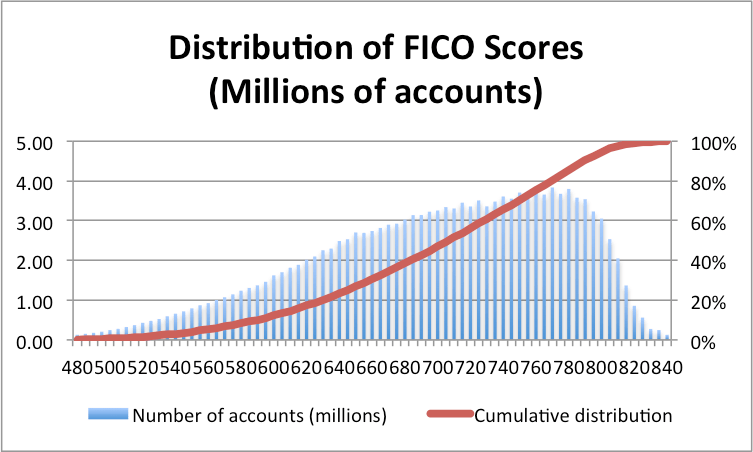
There are variations how to calculate the credit score. Somewhat more technically speaking, the credit score (i.e a single number is the output of the algorithm), and the simplest way to get is by summing the weighted inputs.  FICO uses a scale which runs from 300 to 850. As a blogger writes: “FICO should disclose what goes into its all important algorithms. They say they don’t want people to game them, but considering their importance in buying a house or a car, it can’t be a black box, that only FICO knows”. Figuere shows the national distribution of the FICO scores.

Stay tuned! next post: Struggle for fairness


Credit scores: a little history

Buy, buy, buy! We want to buy even we cannot afford it. Therefore if you need money you should ask somebody to lend you. This ”somebody” (whoever she is, your friend
or a bank) has a single question: ”May I trust the borrower will repay the loan?” In a world when people did not live in the ocean of data the potential lenders characterized qualitatively the borrowers. “He looks a nice, reliable guy, well, I think he will repay… in addition, he promised to pay this and this percent of interest”. Owners of corner grocery stores developed skills for century to classify clients, as reliable and not reliable.  I find interesting, but not surprising that the oldest credit reporting agency in the USA emerged from the grocery business. Cator Woolford was a a grocer in Chattanooga, Tennessee. He collected data from his customers, produced a book, and sold copies of the book to the local Retail Grocer’s Association. Based on his success, together with his younger brother Guy, a lawyer, opened in Atlanta a very small business, they called ”Retail Credit Company”. This small business evolved what we call now Equifax Inc. (one of the three giant consumer credit bureaus, the other two are Experian, and TransUnion), which
collects and process information over 800 million individual consumers.

When people should judge other people’s character, it is truly truly subjective. Granting or denying loans or credit requests was very from being objective, and age-, gender- or race-based discriminations happened again and again. To help the decision makers by quantitative analysis was a big step towards objectivity. William R Fair (1923-1996) and Earl Isaac (1921-1983) started to build mathematical models for predicting the behaviour of the potential borrowers. An initial version of a Credit Application Scoring Algorithm was introduced in 1958. This algorithm generated three possible behaviors: the borrower will pay on time, will pay with delay, or not pay at all. The Fair Isaac Corporation has been established, and developed and algorithm and software to calculate what became the famous/infamous FICO score.

Stay tuned! (How a credit score is calculated, and how objective it is?}